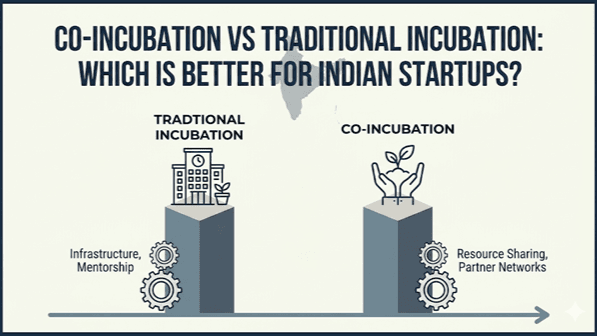
India’s startup ecosystem is one of the most dynamic in the world. With thousands of new ventures emerging every year, founders need the right support to turn ideas into successful businesses. A key decision many face is choosing between traditional incubation and co-incubation. Both models offer valuable help, but they differ in structure, resources, and results.
This article provides a clear, balanced comparison to help founders make informed decisions. We draw on real ecosystem trends and practical insights to guide you.
What is Traditional Incubation?
Traditional incubation is the most common model in India. In this setup, a single organisation such as a university, government-backed centre, or private incubators supports startups under one roof. Founders receive office space, basic mentorship, workshops, legal guidance, and sometimes initial funding.
Programmes linked to Startup India, Atal Innovation Mission (AIM), or university centres like those at IITs and IIMs typically follow this approach.
It works well for early-stage startups that need structure, validation, and a supportive environment. Many Indian success stories began in traditional incubators, gaining confidence and basic business skills.
However, this model has limitations.
A single incubator may not have expertise or facilities for every sector, especially in complex technologies. Access to advanced labs, industry-specific networks, or global markets can be restricted. For founders tackling hard technical problems, progress can sometimes feel slow.
What is Co-Incubation?
Co-incubation is a collaborative model where two or more organisations partner to support a startup. They combine their strengths one may offer business mentorship and investor connects, while another provides advanced technical facilities or market access.
This approach is gaining strong traction in India, particularly for tech ventures. Partnerships between universities, industry bodies, and government hubs allow startups to access a wider range of resources without switching programmes.
This model has gained significant traction globally and is now being adopted in India, driven by government initiatives, IIT and IIM collaborations, and the rise of mission-driven tech startups that simply cannot thrive in a traditional incubation setup.
Difference between Co-Incubation and Traditional Incubation: A Direct Comparison for Founders
Before we go deeper into the benefits, here is a side-by-side co-incubation vs traditional incubator comparison for founders to help you quickly assess which model suits your startup:
- Infrastructure: Traditional incubation relies on the resources of a single incubator but, co-incubation offers shared infrastructure, allowing startups to use combined labs, equipment, and networks across multiple institutions.
- Mentorship: In traditional incubation, mentorship is usually provided by an in-house pool, which may limit the diversity of guidance. But in co-incubation they expand this by offering access to experts from multiple institutions.
- Cost to Startup: Traditional incubation generally involves higher costs since all services are provided by one incubator. Co-incubation reduces costs through a shared model, making it more affordable for startups.
- Network Reach: The network in traditional incubation is typically restricted to a single institution’s ecosystem. Co-incubation significantly broadens this by combining industry and academic connections from multiple partners.
- Stage Flexibility: Traditional incubation usually follows a fixed program structure, which may not suit startups at different growth stages. Co-incubation provides more flexibility by supporting startups across multiple stages in a continuous manner.
Founders who choose wisely based on their sector and stage see better survival rates and faster scaling.
Benefits of Co-Incubation for Tech Startups in India
- Access to Specialised Infrastructure Without the Capital Burden: Co-incubation allows startups to access into shared laboratory facilities, testing infrastructure, and computing resources across partner institutions. Instead of spending crores on building their own labs, startups can access world-class facilities at a fraction of the cost, dramatically reducing their burn rate in the critical early stages.
- Cross-Geography and International Exposure: Several co-incubation models involve international academic or startup ecosystem partners, offering Indian founders a structured path to global markets. This is especially valuable for founders who want to build for global markets from day one.
- Faster Path to Market Validation: Co-incubation programmes that include corporate partners give startups a direct channel to pilot their product within a real business environment. This accelerates market validation, reduces the time to product-market fit, and makes the startup significantly more fundable.
- Reduced Cost with Greater Value: The shared infrastructure benefits in Indian co-incubation centres mean that the per-startup cost of running the programme is distributed across partners, often resulting in lower fees or equity asks from startups. This is particularly important for early-stage founders who are bootstrapping or pre-revenue.
How to Join a Co-Incubation Program in India
Many founders want to know how to join a co-incubation program in India. The process is clear with good preparation.
Build a Strong Foundation: Develop a clear problem statement, prototype or minimum viable product (MVP), team profile, and basic business plan. Show scalability and innovation.
Research Options: Explore Startup India portal, state innovation missions, university incubators, and private programmes. Identify those with co-incubation partnerships in your sector.
Check Fit and Eligibility: Ensure your startup matches the focus area (tech, sustainability, etc.) and meets basic criteria like incorporation status.
Submit Application: Prepare a strong pitch deck, financial projections, and supporting documents. Apply through official portals or emails.
Pitch Effectively: Shortlisted teams present to selection committees. Highlight your vision, traction, and how co-incubation will accelerate growth.
Onboard and Engage: After selection, complete agreements and actively use the available resources and networks.
Which Model Should You Choose?
The honest answer is that the right model depends on your startup's specific needs, stage, and domain. Here is a simple framework to help you decide:
- If you are building an Early-stage startup, a traditional incubator may be sufficient. The structure, community, and basic mentorship of a reputed incubator can provide what you need at this stage.
- If you are running a Deep tech startup, co-incubation is a better choice. The access to specialised infrastructure, domain-specific mentors, and pilot opportunities far outweighs the benefits of a traditional model.
- If you are building an Enterprise tech startup, co-incubation programmes with corporate partners offer invaluable access to enterprise clients and pilot opportunities that traditional incubators simply cannot match.
Conclusion
Choosing between co-incubation and traditional incubation is an important step for any Indian startup. Co-incubation is emerging as a powerful option for tech founders because of its collaborative nature, resource efficiency, and potential for accelerated growth.
Evaluate your needs carefully. Consider your sector, current stage, and long-term vision. The right choice, combined with strong execution, can significantly improve your chances of success.
For founders and researchers who are serious about building something that matters, understanding the co-incubation vs traditional incubator comparison for founders is not an academic exercise it is a strategic decision that can significantly influence the trajectory of your startup.