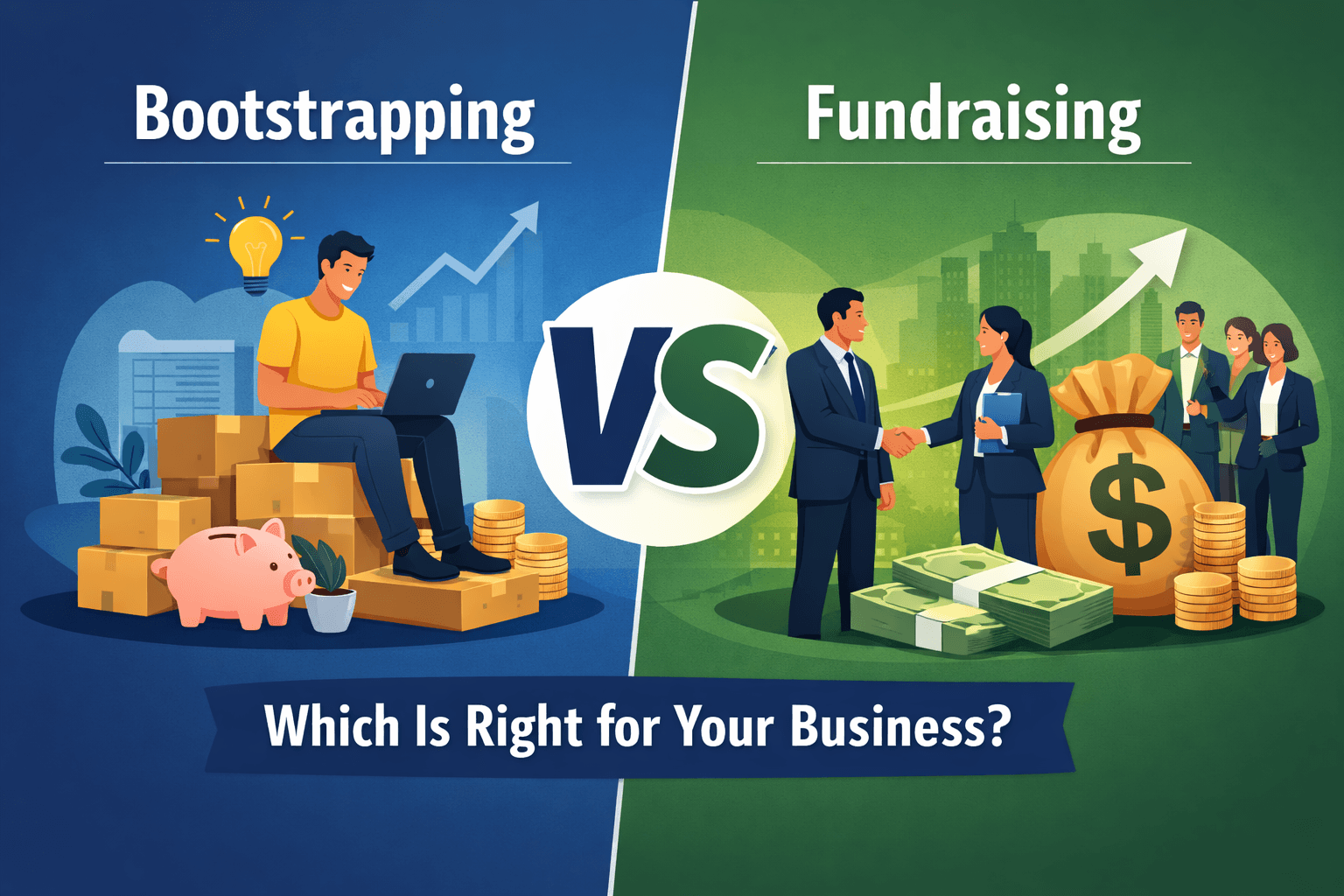
Every founder reaches a stage where money becomes a strategic decision, not just a necessity. Growth demands capital, but the source of that capital shapes everything that follows. The choice between running a bootstrapping business and seeking outside funding is one of the most important decisions in a company’s early life.
This blog clearly breaks down both options to help you find your best business fit.
What does Bootstrapping mean?
Bootstrapping means building and growing your company using your own resources and the revenue generated by the business itself. Most often, this involves self-funding through savings, early cash flow, or limited external assistance from trusted personal networks without giving up ownership.
Many founders rely on personal capital to get their idea off the ground. This might include savings, income from a previous job, or profits from side projects.
Bootstrapped companies usually grow slower than investor-backed firms, but that growth is often more disciplined as every expense is scrutinized, ensuring every new hire truly delivers immediate value.
This mindset builds financial resilience early.
Advantages of Bootstrapping:
Bootstrapping attracts founders who value independence. When you fund your own business, you keep full ownership and complete strategic control.
Another benefit is focus. Without investors to impress, you build for real customers from day one. Your product-market fit develops naturally, not under the pressure of aggressive scaling targets.
Bootstrapping also enforces financial discipline. Limited capital forces smarter decisions around pricing, operations, and hiring.
What does Fundraising mean?
Fundraising means securing money from external sources in exchange for ownership or future returns. This is where equity funding comes into play. Instead of repaying a loan, you give investors a share of your company.
The journey usually starts with seed funding, raised to validate the business model, build the core team, and gain early market traction.
At this stage, some founders turn to angel investment from experienced individuals who offer not only capital but guidance and industry connections.
As the company matures, larger rounds may follow through venture capital firms. These investors bring significant money and the expectation of rapid growth, strong governance, and a high-value exit in the future.
This process of capital raising is structured, time-consuming, and highly competitive. Founders spend months pitching, negotiating terms, and managing investor relationships.
Why Founders Choose Fundraising
The most obvious benefit of fundraising is speed. External money allows you to hire faster, scale operations quickly, invest heavily in marketing, and enter multiple markets at once.
For industries that demand rapid expansion, such as technology, manufacturing, or marketplaces, outside funding can be essential to stay competitive.
Investors also bring more than money. The right backers provide strategic advice, industry connections, mentoring, and credibility in the market. For first-time founders, this support can shorten the learning curve significantly.
Funded companies can also absorb early losses while perfecting their model. This flexibility is often impossible in a bootstrapped setup where every month must stay financially viable.
The Hidden Trade-Offs of Fundraising
While fundraising unlocks growth, it comes with strings attached.
Once you accept outside money, you share ownership and decision-making. Board oversight becomes part of daily operations. Strategic choices must align with investor expectations, not just founder intuition.
There is also pressure to scale aggressively, sometimes before operational stability is fully achieved. Growth becomes a target in itself rather than a by-product of strong fundamentals. For some founders, this shift in priorities creates long-term stress and misalignment.
Dilution is another major consideration. Each funding round reduces your ownership stake. Over time, founders may hold a minority position in the very company they built.
How to Decide Which Path Fits Your Business
The decision between bootstrapping and fundraising depends on a few key questions.
First, examine your industry. Businesses that require heavy upfront investment or must grow quickly to survive usually benefit from fundraising. Software platforms, logistics networks, consumer tech, and deep-tech startups often fall into this category.
Service-based companies, consultancies, niche products, and digital businesses with predictable cash flow can thrive through bootstrapping. These models allow revenue to fund growth naturally over time.
Second, assess your personal risk tolerance. Bootstrapping puts your own finances on the line. If that level of exposure feels overwhelming, sharing risk through investors may be healthier for both you and the business.
Third, have a clear long-term vision. If your goal is to build a large-scale company with a potential global footprint and eventual exit, fundraising often fits well. If you aim to create a sustainable, profitable business with full autonomy, bootstrapping is usually the better match.
Difference between Bootstrapping and Fundraising:
Bootstrapped founders rely primarily on self-funding and reinvested profits controlling all decisions but faces tighter cash flow constraints at the same time. Funded founders exchange a portion of ownership through equity funding for faster access to large capital pools.
Bootstrapped growth is slower but often more sustainable. Funded growth is rapid but comes with performance pressure and external accountability.
Bootstrapped businesses prioritize break-even and profitability. Funded start-ups prioritize scale, market share, and exponential growth.
Understanding these core differences helps remove the emotional bias from the decision-making process.
Making the Right Choice for Your Stage
For founders with a clear way to make money right away and low initial costs, bootstrapping is gold. It gives them room to experiment and instils smart money habits without investor stress.
But if you're building a highly competitive tech product or something that needs a ton of upfront cash, outside funding is usually essential. Waiting too long here can actually sink your potential.
Neither path is failure. The only mistake is choosing a model that doesn't match your business needs or personal vision.
Conclusion
Bootstrapping and fundraising are not opposing ideologies. They're just two different financial tools; each built for a different kind of founder and business. One gives you full freedom and steady, controlled growth; the other provides sheer speed, massive scale, and instant access to powerful connections.
The smartest founders choose based on logic, not trends by evaluating their market, financial capacity, and personal comfort with risk before committing to a funding path.
Whether you grow through disciplined self-reliance or investor-backed acceleration, long-term success still depends on the same fundamentals: a real problem, a strong product, responsible financial management, and consistent execution. Money can shape the journey, but it never replaces the fundamentals that keep a business standing.